
The Cheeseburger Equation
A few months after I finished grad school, I passed a fast food marquee advertising something that I found too tempting to pass up: 50-cent cheeseburgers.
When I got back to my apartment, I found the number for the restaurant and called with a simple question:
“Does that discount apply to bulk orders?”
Two hours later, I returned to the restaurant and purchased a box–yes an entire box, roughly the size of a standard case of copier paper–of cheeseburgers.
For myself.
I had what I thought was an ingenious plan. I purchased 100 complete, ready-to-eat cheeseburgers that day. I was going to freeze them, then thaw one per day in my toaster oven and eat it for lunch for the next 100 days, and thereby save myself a ton of money.
Among my friends, I am and have always been a well-known skinflint. My battle cry is, “Never pay list price.” Some may say that my money-hoarding ways come close to making me a miser, but I prefer to say that I am parsimonious. It sounds better, and fewer people know what it means.
My cheeseburger plan didn’t work out quite like I had planned. Aside from the obvious negative health effects that result from eating cheeseburgers every day for more than three months, the quality of those burgers went downhill fast after I put them in my freezer. And it only got worse the closer I came to the bottom of that box.
I think I wound up throwing away more than two dozen of those frozen cheeseburgers. They were pretty nasty by the end.
For most of my twenties and thirties, I leaned heavily on the excuse that it was okay to eat 50-cent cheeseburgers, $5 pizzas, $7 buffets, and $8 value meals–and to eat them often–because they were all cheap.
True, I would say to myself, usually as I stuffed my face, this deliciously deadly food, eaten in unholy quantities, isn’t good for me, but in the end I’m saving money, and who can afford to eat all of that healthy food, anyway?

The Price of Poor Choices
As it turned out, I was extremely wrong. Most bad-for-you food is cheap in the short-term, but if your life is a never-ending revolving door of one frozen pizza and deep-fried value meal after another as mine used to be, the bill will eventually come due.
The price of poor eating habits is your health, and it is measured in years taken from you instead of dollars spent.
True, a bucket of fried chicken is cheap. And it is delicious. But if you take all of the savings you have from 40 years worth of chicken buckets, how do those savings stack up against medical tests, surgeries, recuperation days, and the endless health problems that can be attributed to a poor diet?
For me, the question was a simple one: is one day less with my wife and daughters worth any amount of money?
Of course not!
Whatever the cost of eating healthy, it is ultimately cheaper than the cost you will pay for eating poorly. As Ann Wigmore said, “The food you eat can be either the safest and most powerful form of medicine or the slowest form of poison.”
But the good news is that you don’t have to break the bank to eat right.
Saving Money and Adding Years
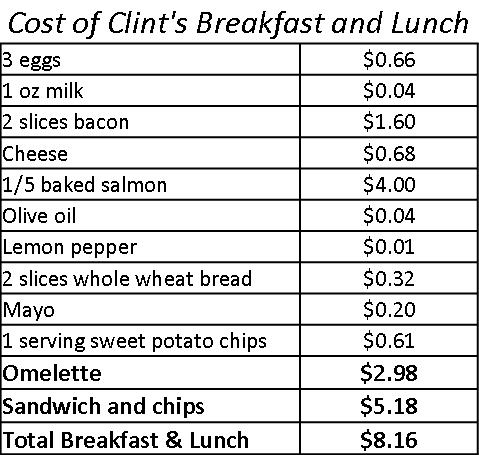
As you may recall from previous posts, I eat pretty much the same thing for breakfast and lunch every day. An omelette for breakfast, and a salmon sandwich for lunch.
I broke down those meals ingredient-by-ingredient with actual costs from my local grocery store. The combined cost for my usual breakfast and lunch is a little over $8 per day.
That’s it.
I went from spending more than $10 a day for lunch alone to spending less than $10 a day on food that I bring from home for 2/3 of my daily meals.
It has been my experience that saving money and losing weight both follow a set of similar rudimentary principles. Those principles are:
- Planning ahead
- Time management
- Impulse control
Saving money and losing weight are both exercises in self-discipline and self-control, two areas where I have always struggled.
The great financial planning guru Dave Ramsey is famous for saying that the definition of maturity is the ability to successfully delay gratification; to focus on what you want most instead of on what you want now.
That is as true for food as it is for money. I have always known that eating too much was bad for my health. But I didn’t succeed at losing weight until, with a great deal of help from my sweet wife, I began to control my desire for food and stopped allowing my desire for food to control me.
Making Time
Saving money depends heavily on sticking to a budget. If you name each dollar and stick to your plan for it, you have taken an important first step in controlling your finances. Losing weight is no different.
Just as you know that certain bills will be due each month, you know that you will probably eat three meals each day. If you put no thought ahead of time into what you will eat for those meals, you will probably make poor diet choices out of haste, just as you may come up short on your bills if you allow them to surprise you every month.
You’re probably going to eat 1,095 meals in a year. You know this now, at this very moment. Take a little time now and plan ahead. Making your lunch the night before is a simple time management habit that can make a huge difference in both your waistline and your budget.
Make time to plan your meals. Make time to exercise each day. Make time to fix your lunch ahead of time.
Make time for your health.
When it comes to your weight, an ounce of prevention is worth a hundred pounds of cure.
Thinner Than I Deserve
It’s not surprising that I gained a great deal of weight during my frozen cheeseburger phase. In fact, that summer, I went above 300 pounds for the first time in my life, and I didn’t see the other side of 300 again for ten years.
I thought that stocking up on cheeseburgers was a good idea. Outwardly, it had all of the hallmarks of a sound financial decision. I took advantage of a limited opportunity. I bought when the price was low. I made plans to maximize the benefit at a greatly-reduced cost.
But the one thing I didn’t take into account when I bought a case of cheeseburgers was my own health and well-being, and I paid the price for it in a rapidly-expanding waistline. My cheeseburger experiment opened the door to a host of other foolish food decisions over the next decade.
Those cheeseburgers wound up being a terrible investment, but they taught me that the best investments aren’t always about adding money to your wallet.
 Half The Guy
Dieting is very expensive! There are a lot of things in my diet I love that cost a lot, good fish, shrimp, lean steak, fresh veggies etc.. but it is totally worth it, two years ago I was the heaviest I had ever been, it took a year but I lost 30 pounds, lately I had slipped a bit, so back I went to my pricey healthy food, well worth it in the long run!
LikeLike